
In many Asian cultures, the first 40 days after childbirth are considered sacred for recovery—a practice often referred to as the “golden month.” From a Traditional Chinese Medicine (TCM) perspective, this time is not superstition but rooted in a deep understanding of the body’s physiology.
Childbirth is seen as a moment of both depletion and renewal. A woman loses a large amount of Qi and Blood, and her body is temporarily vulnerable. At the same time, the uterus and channels are open, leaving her susceptible to Cold, Damp, or external pathogens. The first 40 days are therefore essential for restoring Qi, rebuilding Blood, tonifying the Kidneys, and protecting against future chronic conditions.
Failing to rest and recover adequately during this period may lead to long-term health issues, such as fatigue, back pain, joint stiffness, menstrual irregularities, depression, or even early aging.
Key Organ Systems Involved
- Spleen (Pi, 脾)
- Governs transformation of food into Qi and Blood.
- Weakness post-birth → poor appetite, fatigue, loose stools, poor lactation.
- Liver (Gan, 肝)
- Stores and regulates Blood.
- Imbalance → emotional swings, postpartum depression, menstrual irregularities.
- Heart (Xin, 心)
- Houses the Shen (mind/spirit).
- Deficiency → anxiety, insomnia, palpitations, restlessness.
- Kidney (Shen, 腎)
- Stores Essence (Jing), governs reproduction and recovery.
- Weakness → back pain, night sweats, urinary problems, prolonged fatigue.
Common TCM Patterns in Postpartum Recovery
Qi and Blood Deficiency
- Symptoms: fatigue, pale complexion, dizziness, scanty lactation, low appetite.
- Tongue: pale.
- Pulse: weak, thready.
Blood Stasis
- Symptoms: abdominal pain, dark clotted lochia, delayed recovery, depression.
- Tongue: dark or purplish.
- Pulse: choppy.
Kidney Deficiency (Yin or Yang)
- Symptoms: back pain, urinary issues, night sweats, infertility risk later.
- Tongue: pale (Yang def.) or red with little coat (Yin def.).
- Pulse: deep, weak.
Invasion of Cold/Damp
- Symptoms: joint pain, body aches, abdominal cold, chronic fatigue if untreated.
- Tongue: pale, moist.
- Pulse: slow.
Treatment Principles in TCM
- Tonify Qi and Blood to restore strength and lactation.
- Nourish Kidneys to rebuild Essence and long-term vitality.
- Move Blood gently to prevent stasis and aid uterine recovery.
- Calm the Shen to ease anxiety and support emotional balance.
- Protect against Cold/Damp by keeping the body warm.
Diet and Lifestyle Tips (TCM-Based)
Diet Tips
- Qi & Blood Nourishing: chicken soup, beef, red dates, goji berries, longan fruit, bone broth.
- Kidney Support: walnuts, black sesame, black beans, lamb, seaweed.
- Avoid Cold/Damp Foods: raw vegetables, iced drinks, excess dairy.
- Herbal broths: ginger, dang gui (angelica sinensis), and rice porridge to warm and nourish.
Lifestyle Tips
- Rest as much as possible during the first 40 days; avoid overexertion.
- Keep body and abdomen warm; avoid exposure to cold wind or damp environments.
- Light stretching only after 3–4 weeks, no vigorous exercise too early.
- Emotional care: practice relaxation, gentle breathing, and receive family support.
- Maintain regular, warm meals to rebuild Qi.
Daily Acupressure for Postpartum Recovery
SP6 – Sanyinjiao (三陰交)
- Location: 3 cun above the medial ankle.
- Function: Tonifies Blood, strengthens Spleen & Kidney, supports uterus recovery.
ST36 – Zusanli (足三里)
- Location: 3 cun below the knee, one finger lateral to tibia.
- Function: Boosts Qi, strengthens digestion, improves fatigue.
REN4 – Guanyuan (關元)
- Location: 3 cun below the navel.
- Function: Tonifies Kidney, nourishes Qi and Blood, restores reproductive energy.
HT7 – Shenmen (神門)
- Location: At wrist crease, radial side of pisiform.
- Function: Calms Shen, improves sleep, reduces anxiety.
BL32 – Ciliao (次髎)
- Location: In the 2nd sacral foramen.
- Function: Regulates uterus, relieves postpartum pelvic pain.
Technique: Apply gentle pressure 1–2 minutes per point daily with slow breathing.
TCM Treatment Recommendations
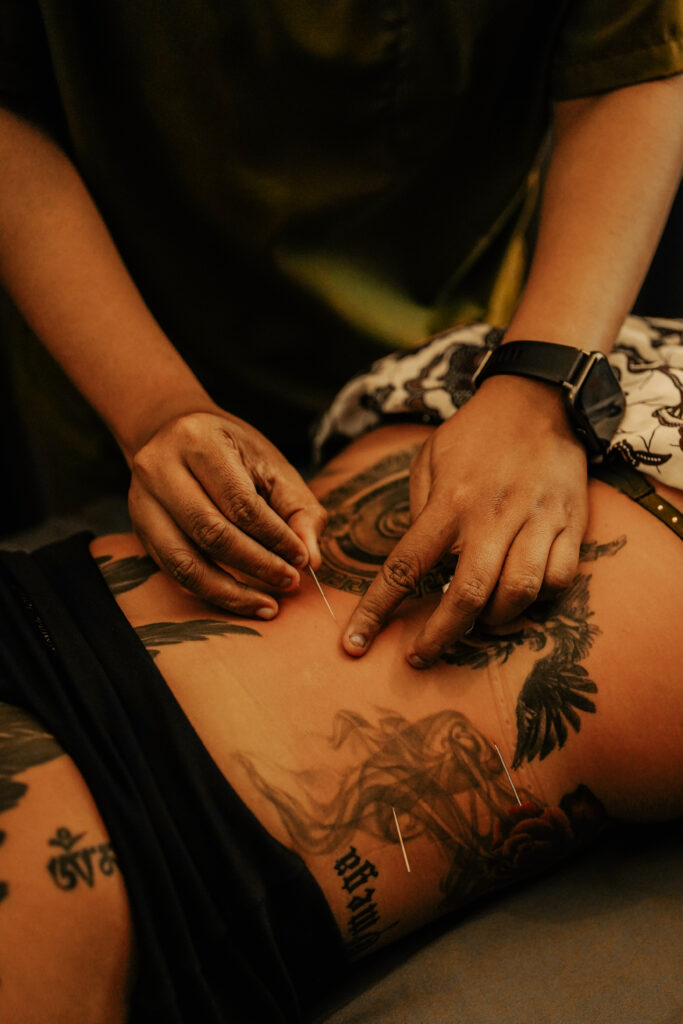
- Acupuncture:
- To tonify Qi & Blood: ST36, SP6, REN6, BL20.
- To nourish Kidneys: KI3, REN4, BL23.
- To calm Shen: HT7, PC6, Yin Tang.
- Herbal Medicine:
- Sheng Hua Tang → classic postpartum formula for lochia retention and Blood stasis.
- Ba Zhen Tang → for Qi and Blood deficiency with fatigue.
- Si Wu Tang → for Blood deficiency with pale complexion and dizziness.
- You Gui Wan → for Kidney Yang deficiency in chronic fatigue or coldness.
- Moxibustion: On REN4 and BL23 to warm the uterus and strengthen Yang.
- Massage/Tuina: Gentle abdominal massage to improve lochia flow.
Conclusion
The first 40 days after childbirth are not simply cultural tradition but a critical window for long-term health. TCM views postpartum recovery as a time to rebuild Qi, nourish Blood, and restore Kidney Essence. Neglecting this period may lead to chronic fatigue, joint pain, menstrual problems, or emotional imbalance later in life.
With the right combination of diet, rest, emotional care, acupuncture, and herbal support, women can use this “golden month” to lay a foundation of health, vitality, and resilience for years to come.
Sources
- Liu, Yan & Liu, Zhanwen. Traditional Chinese Medicine in Obstetrics and Gynecology. People’s Medical Publishing House, 2010.
- Scheid, Volker. Chinese Medicine in Contemporary China: Plurality and Synthesis. Duke University Press, 2002.
- Flaws, Bob. A Handbook of Chinese Medical Gynecology. Blue Poppy Press, 2003.