
In Traditional Chinese Medicine (TCM), the menstrual cycle depends on the balance of Yin and Yang. Yin represents coolness, rest, nourishment, and fluids. It anchors the cycle, supports Blood production, and maintains fertility.
When Yin becomes deficient, the body loses its cooling and moistening qualities. For women, this often shows up as shortened cycles, scanty periods, hot flashes, night sweats, anxiety, and insomnia. From a TCM perspective, irregular menstruation is not only a hormonal issue but also a sign that the body’s Yin reserves are running low.
Key Organ Systems Involved
- Kidney (Shen, 腎)
- Stores Jing (Essence) and governs growth, reproduction, and menstruation.
- Kidney Yin deficiency → leads to short cycles, scanty flow, infertility, hot flashes, and lower back weakness.
- Liver (Gan, 肝)
- Stores Blood and regulates smooth Qi flow.
- Liver Yin deficiency → causes PMS, irritability, headaches, dry eyes, irregular bleeding.
- Heart (Xin, 心)
- Houses the Shen (mind/spirit) and supports Blood circulation to the uterus.
- Heart Yin deficiency → triggers anxiety, palpitations, poor sleep, and worsens cycle irregularity.
- Spleen (Pi, 脾)
- Generates Qi and Blood from food.
- Weak Spleen function → reduces Blood supply, aggravating Yin and menstrual imbalance.
Common TCM Patterns for Irregular Periods due to Yin Deficiency
Kidney Yin Deficiency
- Symptoms: short cycles, light or scanty flow, dizziness, tinnitus, night sweats, dry mouth, lower back pain.
- Tongue: red, little or no coating.
- Pulse: thin and rapid.
Liver Yin Deficiency
- Symptoms: irregular cycles, PMS, scanty flow, irritability, headaches, insomnia, dry eyes.
- Tongue: red sides, thin coat or no coat.
- Pulse: wiry, thin.
Heart and Kidney Yin Deficiency
- Symptoms: irregular cycles, palpitations, anxiety, poor sleep, forgetfulness, night sweats.
- Tongue: red, tip redder, no coat.
- Pulse: thin, rapid.
Treatment Principles in TCM
- Nourish Kidney Yin to replenish Essence and restore reproductive balance.
- Tonify Liver Yin & Blood to regulate menstruation and calm emotions.
- Harmonize Heart and Kidney to anchor the Shen and improve sleep.
- Strengthen Spleen Qi to generate sufficient Blood and support Yin.
Diet and Lifestyle Tips (TCM-Based)
Diet Tips
- Nourish Yin: pears, watermelon, cucumber, tofu, almonds, black sesame, mulberries, seaweed.
- Nourish Blood: red dates, longan fruit, spinach, eggs, bone broth.
- Avoid: hot, spicy foods, fried/greasy meals, alcohol, excess caffeine (all damage Yin).
- Helpful drinks: chrysanthemum tea, goji–jujube tea, mung bean soup.
Lifestyle Tips
- Sleep before 11 p.m. to preserve Yin.
- Avoid overwork and late nights.
- Practice gentle Qi Gong, yoga, or Tai Chi.
- Apply a warm compress to the lower abdomen during menstruation.
- Practice deep breathing or meditation to calm the Shen.
Daily Acupressure for Menstrual Balance
SP6 – Sanyinjiao (三陰交)
- Location: 3 cun above the medial ankle (inner side of the leg).
- Function: Nourishes Yin, harmonizes Liver–Spleen–Kidney, regulates cycles.
KI3 – Taixi (太溪)
- Location: Between the medial ankle and Achilles tendon.
- Function: Nourishes Kidney Yin, strengthens Jing, reduces heat.
REN4 – Guanyuan (關元)
- Location: 3 cun below the navel.
- Function: Tonifies Kidney, nourishes Yin, regulates uterus.
LV3 – Taichong (太沖)
- Location: Top of the foot, between the 1st and 2nd metatarsal bones.
- Function: Moves Liver Qi, relieves PMS and stress.
HT7 – Shenmen (神門)
- Location: At the wrist crease, radial side of the pisiform bone.
- Function: Calms the Shen, improves sleep, reduces anxiety.
Technique: Apply gentle pressure for 1–2 minutes per point while breathing slowly.
TCM Treatment Recommendations
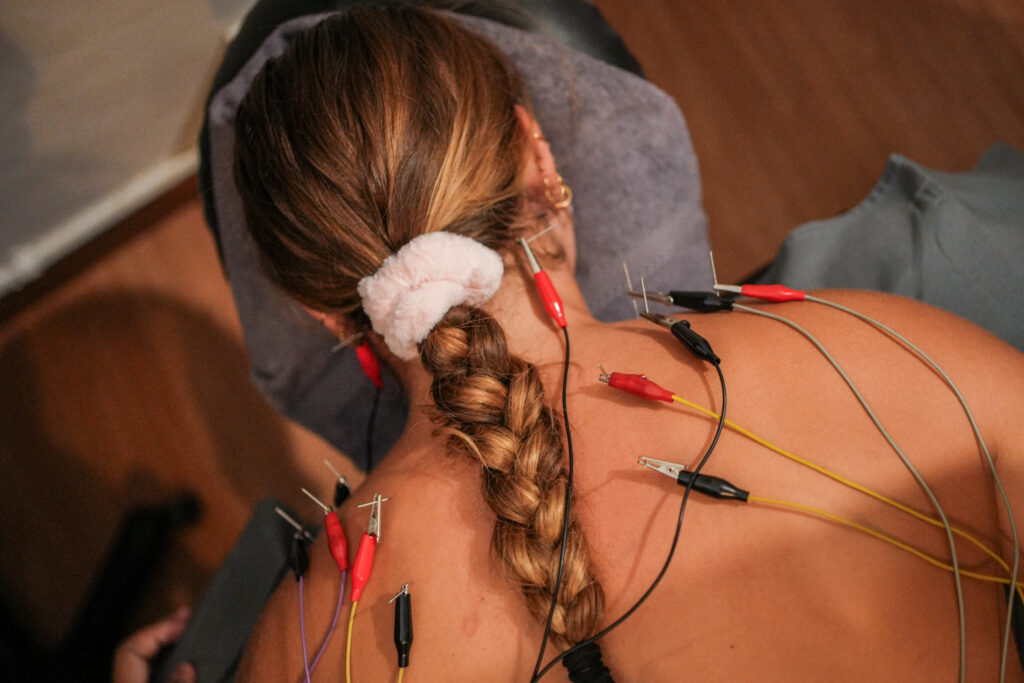
- Acupuncture: Use SP6, KI3, REN4, LV3, HT7 to nourish Yin, regulate cycles, and calm emotions.
- Herbal Medicine:
- Zuo Gui Wan → severe Kidney Yin deficiency with infertility or scanty periods.
- Liu Wei Di Huang Wan → Kidney Yin deficiency with heat and irregular cycles.
- Ba Zhen Tang → combined Qi and Blood deficiency worsening Yin weakness.
- Moxibustion: used cautiously, mainly in mixed cases with Yang deficiency.
- Qi Gong / Meditation: to preserve Yin, reduce stress, and regulate emotional balance.
Conclusion
In TCM, Yin is the foundation of women’s reproductive health. When Yin is deficient, cycles shorten, flow becomes scanty, and emotional symptoms like anxiety or poor sleep appear. By nourishing Yin through diet, lifestyle, acupuncture, herbal medicine, and self-care, women can restore balance, regulate their periods, and support long-term vitality.
Sources
- Flaws, Bob & Sionneau, Philippe. The Treatment of Modern Western Medical Diseases with Chinese Medicine: A Textbook & Clinical Manual. Blue Poppy Press, 2001.
- Larre, Claude & Rochat de la Vallée, Elisabeth. The Kidney in Chinese Medicine. Monkey Press, 1996.
- Wiseman, Nigel & Ellis, Andrew. Fundamentals of Chinese Medicine. Paradigm Publications, 1996.