
Understanding Low Back Pain After Exercise in TCM
In Traditional Chinese Medicine (TCM), the low back is considered the “house of the Kidneys.” The Kidney (Shen) stores Essence (Jing) and governs bones, marrow, and the strength of the lumbar region. After intense or excessive exercise, low back pain can develop not just from mechanical strain but also from internal imbalance particularly involving the Kidneys, Liver, and Spleen.
Overexertion consumes Qi, Blood, and Essence, leading to weakness in the lumbar area. It may also cause Qi and Blood stagnation, creating stiffness and soreness. When these imbalances persist, recovery slows and chronic low back discomfort may follow.
Key Organ Systems Involved
- Kidney (Shen)
- Governs bones and stores Essence.
- Weakness causes low back soreness and poor recovery after activity.
- Liver (Gan)
- Stores Blood and nourishes sinews.
- Overuse of muscles consumes Liver Blood, leading to stiffness and cramps.
- Spleen (Pi)
- Produces Qi and Blood from food.
- Deficiency results in fatigue, poor muscle recovery, and damp accumulation in the low back.
- Urinary Bladder Channel
- Runs along the back. Stagnation of Qi and Blood here contributes to acute pain.
Common TCM Patterns for Post-Exercise Low Back Pain
- Kidney Qi or Yin Deficiency
- Symptoms: dull low back pain after exercise, fatigue, weak knees, worse in the evening.
- Tongue: pale or red with scanty coat.
- Pulse: weak or thin.
- Qi and Blood Stagnation
- Symptoms: sharp, stabbing low back pain, worse with pressure or movement, may follow injury.
- Tongue: purple or with dark spots.
- Pulse: choppy.
- Liver Blood Deficiency
- Symptoms: muscle tightness, spasms, poor recovery, dizziness.
- Tongue: pale.
- Pulse: thin.
- Damp-Cold Invasion
- Symptoms: heavy, achy low back pain, worse in damp or cold weather, better with warmth.
- Tongue: pale with white greasy coating.
- Pulse: slow and slippery.
Treatment Principles in TCM
- Tonify Kidney Qi, Yin, or Yang to strengthen the lumbar region.
- Move Qi and invigorate Blood to relieve pain and stiffness.
- Nourish Liver Blood to support tendons and muscles.
- Dispel Damp and Cold from the channels when external factors worsen pain.
- Balance exertion with recovery to prevent further depletion.
Diet and Lifestyle Tips (TCM-Based)
Diet Tips
- For Kidney support: black beans, walnuts, bone broth, goji berries, sesame seeds.
- For Blood nourishment: spinach, beets, dates, lean red meat.
- To expel Cold-Damp: ginger, cinnamon, garlic, warm soups.
- Avoid: raw/cold foods, excessive sugar, alcohol (which worsens Damp).
Lifestyle Tips
- Warm up before exercise and cool down properly.
- Avoid overexertion listen to body signals.
- Keep the low back warm, especially after sweating.
- Practice restorative exercises like Qigong or Tai Chi to replenish Qi.
- Allow adequate rest and sleep for recovery.
Daily Acupressure for Low Back Pain After Exercise
- BL23 – Shen Shu (腎俞)
- Location: 1.5 cun lateral to the lower border of L2.
- Function: Strengthens Kidneys, relieves low back pain.
- BL40 – Wei Zhong (委中)
- Location: At the midpoint of the popliteal crease (behind the knee).
- Function: Clears stagnation from the Urinary Bladder channel, relieves acute low back pain.
- GV4 – Ming Men (命門)
- Location: On the midline, below the spinous process of L2.
- Function: Tonifies Kidney Yang, strengthens the lumbar area.
- KD3 – Tai Xi (太溪)
- Location: In the depression between the medial malleolus and Achilles tendon.
- Function: Tonifies Kidney Qi and Yin, alleviates chronic soreness.
- GB34 – Yang Ling Quan (陽陵泉)
- Location: Below the knee, in the depression anterior and inferior to the fibula head.
- Function: Benefits tendons, relieves muscular stiffness post-exercise.
Technique: Press gently for 1–2 minutes per point, once or twice daily. Combine with slow breathing.
TCM Treatment Recommendations
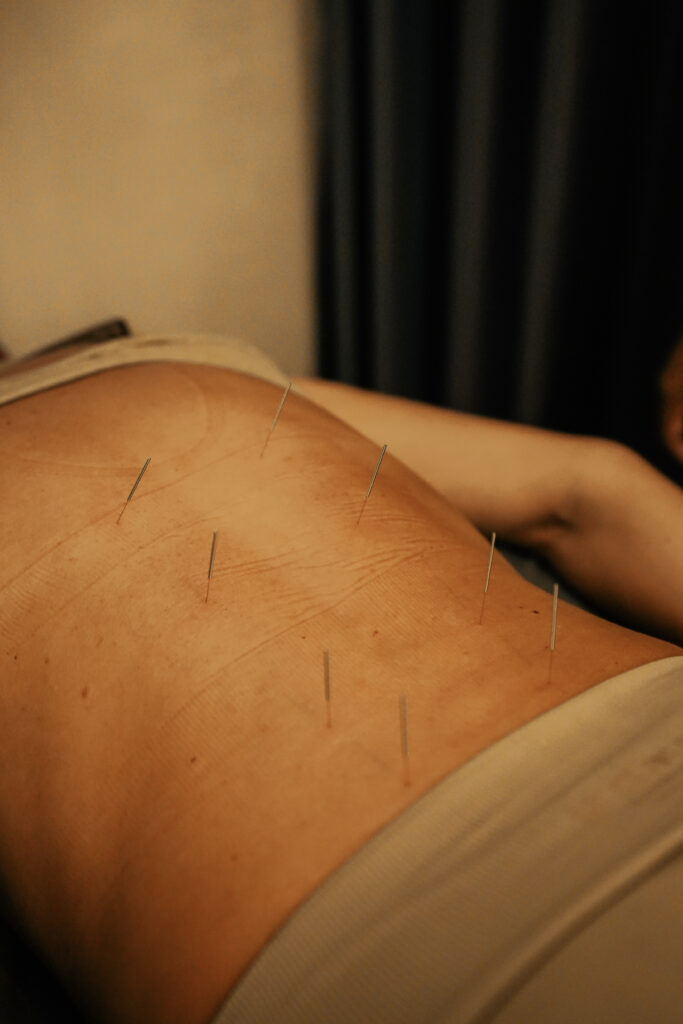
- Acupuncture: Points like BL23, BL40, GV4, KD3, GB34 for strengthening Kidneys and moving stagnation.
- Cupping or Gua Sha: on the low back or Bladder channel to release stagnation.
- Moxibustion: for Cold-Damp patterns or chronic deficiency.
Conclusion
From a TCM perspective, low back pain after exercise is not just muscular strain—it reflects imbalance in Qi, Blood, and Kidney function caused by overexertion. By restoring harmony through acupuncture, herbal medicine, diet, lifestyle adjustments, and acupressure, both pain relief and long-term resilience of the low back can be achieved. Balancing effort with proper recovery is key to preventing future episodes.
Sources
- Maciocia, Giovanni. The Practice of Chinese Medicine. Elsevier, 2005. ISBN: 9780443074905
- Deadman, Peter, Al-Khafaji, M., & Baker, K. A Manual of Acupuncture. Journal of Chinese Medicine Publications, 2007. ISBN: 09510546513.
- Chen, John K., & Chen, Tina T. Chinese Medical Herbology and Pharmacology. Art of Medicine Press, 2004. ISBN: 97809740635